

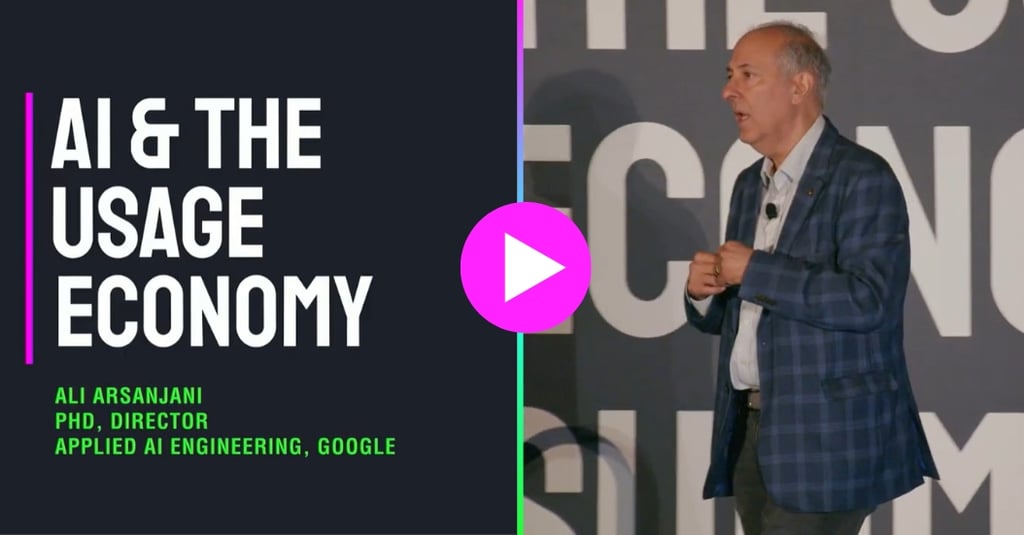
The global technology landscape is shifting from a mature SaaS economy to a fast-evolving AI economy defined by unprecedented capital investment, rising compute demands, and a rapidly expanding class of intelligent agents. Dr. Ali Arsanjani’s presentation at the Usage Economy Summit captured the scale of this transformation and its implications for how businesses must rethink value creation, cost structures, and monetization.
The message is clear. AI is no longer an enhancement to existing offerings. It represents a structural change in how labor, compute, and intelligence are measured, priced, and monetized.
The Economic Shift Behind Agentic AI
Enterprise AI development is supported by massive investment. By some estimates, cumulative global capital expenditure on data centers exceeds seven trillion dollars. Two thirds lies in compute architectures. The remainder is consumed by power, land, and the infrastructure required to train, deploy, and operate advanced models.
This scale of investment is reshaping the unit economics of software. Traditional SaaS models were built on near zero marginal cost. AI breaks that paradigm. Every inference has a cost. Every workflow has a token budget. Compute becomes a proxy for labor.
Businesses cannot assume that current AI cost structures will remain sustainable. Nor can they rely on generic models to deliver differentiated value. The future belongs to companies that build domain-specific intelligence and package it through monetization models that align usage, value, and cost.
Agents Are Redefining How Work Is Done
Dr. Arsanjani explained that modern LLMs have transitioned from static information retrieval systems to “thinking models” capable of reasoning, planning, and making complex decisions. These models form the foundation of agentic AI: systems that perceive their environment, formulate plans, coordinate with other agents, and execute tasks on behalf of humans.
This shift introduces new economic patterns:
- Labor becomes elastic because digital labor can be scaled with compute rather than headcount.
- Workflows are decomposed into task units that can be reassembled into hybrid human–agent processes.
- Compute becomes a form of workforce capacity, requiring tight cost governance.
- Domain-specific agents become a primary source of competitive differentiation.
The companies that master these patterns will redefine productivity and expand margins.
Why Monetization Must Evolve Alongside AI
As agentic AI grows, monetization must evolve beyond static subscriptions. The economics of AI favor models that directly connect compute cost to customer value. Three principles emerge.
1. Usage-Based and Hybrid Pricing Will Become Essential
AI introduces variable cost structures. Prompt execution, token consumption, and compute cycles fluctuate based on workflows. This makes usage-based and hybrid monetization models critical.
Vendors must meter the value their agents deliver and align pricing to consumption. Token-based pricing, workflow-based pricing, and compute-tier pricing will become foundational elements in enterprise monetization strategies.
2. Domain-Specific Agents Create Pricing Power
Generic models are becoming commodities. The real value lies in agents tuned on proprietary data and tailored to specific industries such as financial services, supply chain, telco, or healthcare.
Domain-specific agents allow companies to:
- Charge premium prices for specialized intelligence.
- Introduce new monetizable modules and expansions.
- Differentiate on capability, speed, and accuracy rather than raw model size.
This supports higher NRR, stronger expansion paths, and more defensible pricing.
3. Governance and Cost Transparency Will Influence How AI Is Sold
Token budgets, inference cost caps, and controllable computing limits become monetizable features. Customers will not tolerate unpredictable AI costs. They will expect clarity, governance, and guardrails.
This opens opportunities for new revenue models, including:
- Predictable commitment tiers for compute.
- Add-on governance features priced as premium modules.
- “Performance guarantees” tied to cost savings or output efficiency.
A New S-Curve for AI Adoption and Monetization
Traditional technology adoption follows a slow-start S-curve. AI reverses this. Innovation moves from zero to sixty almost instantly. The middle phase is volatile. Plateaus come faster.
This compressed S-curve forces companies to treat AI investment like an options portfolio rather than a linear roadmap. Small, compounding bets on agentic workflows, domain models, and automation paths create future revenue opportunities.
Those who wait for perfect clarity will be left behind. Those who build early operational muscle will shape customer expectations and define the pricing standards of the next decade.
Building a Monetization Strategy for the Agentic Era
To compete effectively, businesses need a clear economic and operational blueprint:
- Reassess your unit economics with compute as a labor force multiplier.
- Decompose jobs into task-level workflows that can be metered, automated, and monetized.
- Design pricing models that track usage, cost, and measurable outcomes.
- Consolidate your AI technology stack and build domain-specific agents that deepen differentiation.
- Implement governance, auditability, and cost controls as part of the monetization package.
- Treat AI initiatives as a portfolio of strategic options rather than single high-risk projects.
AI will only deliver profit if the value story, pricing model, and cost governance are engineered with the same rigor as the technology itself.
Conclusion
Dr. Arsanjani’s perspective highlights the most important strategic truth of the AI era. Intelligence is becoming a scalable economic resource. Compute is becoming labor. Agents are becoming digital workers.
The companies that thrive will not simply adopt agentic AI. They will monetize it intelligently. They will align cost with consumption. They will differentiate through domain expertise. They will build governance into their value proposition.
Most importantly, they will design pricing models that reflect the real economics of AI, enabling sustainable growth in a world that is moving faster than ever before.
Watch Dr. Ali Arsanjani’s full presentation to understand how agentic AI, compute economics, and next-generation automation will reshape monetization strategies and long-term competitive advantage.
Comments