

As AI agents evolve to handle complex workflows and automate critical tasks, businesses have an unprecedented opportunity to monetize these transformative technologies. However, unlocking the full value of AI agents requires more than innovative product development—it demands a strategic and scalable pricing model that aligns with customer usage and value delivery. A usage-based pricing (UBP) Go-to-Market (GTM) strategy offers an ideal framework for companies to capitalize on this potential.
Why Usage-Based Pricing Works for AI Agents
AI agents are inherently dynamic, adapting to workloads and scaling with customer needs. Usage-based pricing complements this flexibility, enabling companies to:
- Align Revenue with Customer Value or Outcomes: Pricing is tied to measurable outputs like the number of tasks completed, API calls, tickets resolved or workflows automated.
- Attract a Broader Customer Base: Lower entry costs appeal to smaller businesses or early adopters hesitant about large upfront investments.
- Encourage Adoption and Expansion: As customers see value, their usage—and consequently their spending—naturally grows.
- Stay Competitive: Usage-based pricing aligns with market expectations in an era of cloud-native, scalable solutions and a rush to capture AI market share.
Steps to Implement a UBP Strategy for AI Agents
1. Define Usage Metrics
The foundation of UBP is identifying clear, measurable metrics tied to customer value. For AI agents, potential metrics include:
- Task-Based Metrics: Number of tasks completed (e.g., tickets resolved, leads qualified).
- Time-Based Metrics: Hours of active usage or agent runtime.
- Outcome-Based Metrics: ROI-driven outcomes, such as cost savings or revenue generated.
2. Build Tiered Pricing Models
Tiered pricing allows companies to cater to varying customer needs:
- Freemium Tiers: Offer basic features with limited usage for free to encourage adoption.
- Pay-as-You-Go: Charge based on actual usage, ideal for startups or fluctuating workflows.
- Enterprise Plans: Offer predictable pricing with a cap on maximum usage for large-scale clients.
3. Design Transparent Billing
Customers value clarity. Provide detailed invoices showing:
- Tasks completed by the AI agent.
- Usage trends over time.
- Cost savings or efficiency metrics achieved via automation.
4. Enable Predictable Scaling
Ensure the pricing model supports predictable scaling:
- Offer volume discounts to encourage higher usage.
- Include usage thresholds to help customers forecast costs and avoid surprises.
Key Considerations for GTM Execution
1. Focus on High-Value Use Cases
To drive adoption, target industries and use cases where AI agents deliver tangible ROI. Examples include:
- Customer Support: Automating ticket resolution and reducing staffing costs.
- Sales: Scaling lead qualification and outreach to boost revenue.
- Cybersecurity: Rapid threat detection and remediation for cost savings.
2. Build Trust with Case Studies
Customers are wary of new technologies, especially those automating critical tasks. Address these concerns by:
- Sharing success stories that quantify value (e.g., “Reduced customer support costs by 40%”).
- Highlighting reliability and accuracy through metrics like resolution rates or ROI.
3. Provide Flexible Integration
Make it easy for customers to adopt AI agents by offering seamless integrations with their existing tools (e.g., CRMs, ticketing systems, or coding platforms). Flexibility in deployment ensures higher usage and customer satisfaction.
4. Offer Scalable Onboarding
Introduce customers to AI agents with minimal friction:
- Use free trials or credits to demonstrate value.
- Provide self-service resources like tutorials, sandboxes, and analytics dashboards.
- Enable consultative sales for enterprise clients to ensure proper alignment of use cases and pricing.
Conclusion: Transforming AI Agent Adoption with UBP
A usage-based pricing strategy enables companies to monetize AI agents effectively by aligning revenue with customer value and outcomes. It lowers barriers to adoption, drives customer loyalty, and positions businesses to scale revenue as usage grows. By combining flexible pricing models with targeted marketing and seamless integrations, enterprises can transform how they deliver—and profit from—the next generation of intelligent automation.
How AI Is Shaping Monetization
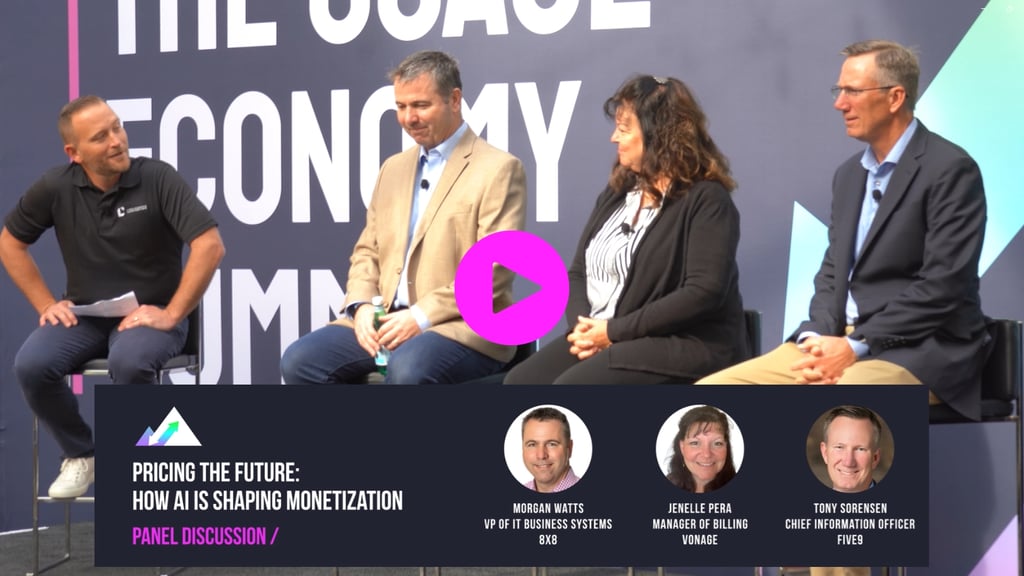
The Usage Economy Summit 2024 delivered a groundbreaking discussion in our session, “Pricing the Future: How AI Is Shaping Monetization”. This engaging panel, featuring industry leaders from Five9, 8×8, and Vonage, dives deep into how AI-driven innovations are revolutionizing pricing strategies across SaaS and subscription models. Watch the panel discussion now.
Comments