

As artificial intelligence becomes deeply embedded across industries, one question has become central to its commercial success: how should AI solutions be priced?
Whether you’re building AI tools, purchasing them for your business, or reevaluating your go-to-market model, it’s crucial to understand the strengths and weaknesses of today’s most common AI pricing models:
- Usage-Based Pricing
- Outcome-Based Pricing
- Subscription-Based Pricing
In this guide, we’ll explore how each model works, when to use them, and how they align with value delivery in enterprise environments.
What Is Usage-Based Pricing for AI?
Definition:
Usage-based pricing charges customers according to how much they use the AI product. This could mean per API call, number of AI-generated outputs, compute time, or tokens processed (as with LLMs).
Benefits of Usage-Based Pricing:
- Scales with adoption: Customers only pay for what they use, supporting elastic demand.
- Encourages experimentation: Reduces friction for initial adoption or pilot testing.
- Value transparency: Cost directly reflects usage intensity.
Challenges:
- Unpredictable costs: Customers may struggle with budgeting, especially as AI usage grows. This can be counteracted by providing tiered pricing or consumption drawdown models with predetermined monthly spending budgets.
- Billing complexity: Requires detailed usage metering and real-time cost visibility.
- Discourages high-volume use: Cost-conscious buyers may limit usage, even if value is delivered
Best for:
- AI API platforms (e.g., OpenAI, Anthropic)
- Developer and data science tools
- Early-stage or exploratory AI deployments
What Is Outcome-Based Pricing for AI?
Definition:
Outcome-based pricing charges customers based on specific business results achieved through the AI solution, such as revenue growth, cost savings, improved productivity, or higher conversions.
Benefits of Outcome-Based Pricing:
- Strong alignment: Customers pay when value is delivered.
- Premium justified: Pricing scales with impact, not inputs.
- Partnership mindset: Fosters long-term, trust-based relationships.
Challenges:
- Hard to quantify: It can be difficult to attribute outcomes solely to AI.
- Longer sales cycles: Defining metrics and success criteria takes time.
- Higher vendor risk: AI providers bear more accountability for performance.
Best for:
- AI-powered predictive analytics
- AI in healthcare diagnostics or financial forecasting
- Enterprise AI solutions tied to ROI or SLA-driven outcomes
What Is Subscription-Based Pricing for AI?
Definition:
In a subscription pricing model, customers pay a recurring fee (monthly, quarterly, or annually) to access the AI platform or application, regardless of how much they use it.
Benefits of Subscription Pricing:
- Predictable billing: Simplifies procurement and budgeting.
- Easy onboarding: Low-friction model for procurement teams.
- Bundled services: Can include onboarding, updates, and customer success support.
Challenges:
- Flat-rate inefficiencies: Costs may not scale with usage or perceived value.
- Churn risk: Customers may cancel if they feel underutilized or undervalued.
- Value misalignment: May not reflect the actual impact of the AI.
Best for:
- AI SaaS tools for marketing, HR, CRM, and finance
- Established enterprise software with embedded AI features
- Low-variance workloads
How to Choose the Right AI Pricing Model
Choosing the right monetization strategy for your AI solution is about aligning pricing with the value delivered and the customer’s stage of AI maturity.
| Buyer Maturity | Ideal Pricing Model |
| Early-Stage / Experimental | Usage-Based |
| Value-Focused / Results-Driven | Outcome-Based |
| Standardized / Operational Use | Subscription-Based |
For vendors, hybrid pricing (e.g., base subscription + metered usage) often offers the best of both worlds—predictable revenue and scalable upside.
For buyers, understanding the billing logic behind the AI you’re adopting can help negotiate better contracts, predict ROI, and align pricing with internal budgeting needs.
The Future of AI Monetization: Flexibility, Fairness, and Alignment
As the AI economy matures, pricing will become not just a commercial decision but a competitive differentiator. Models that reward value creation—not just volume—will win the trust of enterprise buyers.
Vendors that understand and clearly communicate how their pricing maps to business outcomes will not only grow revenue—they’ll build lasting relationships.
Join the Conversation at the Usage Economy Summit 2025
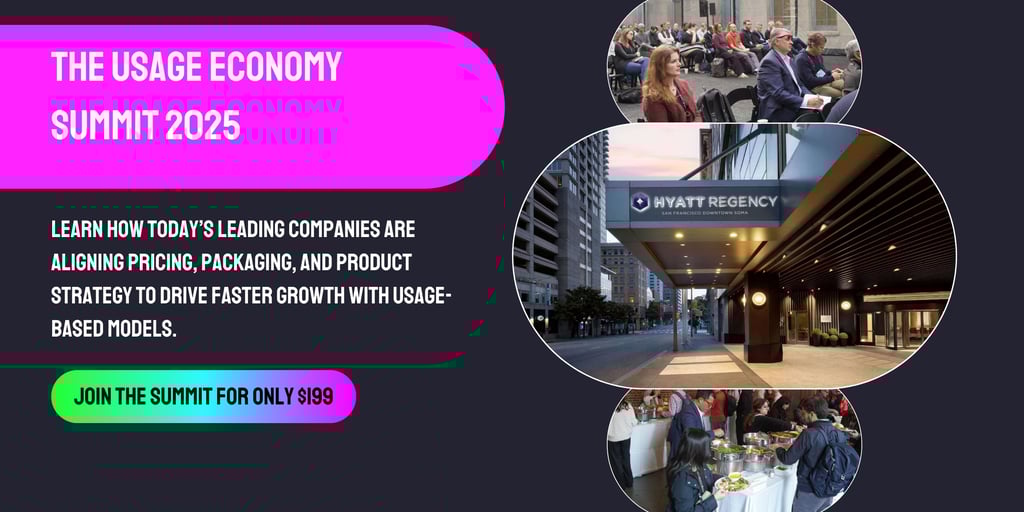
If you’re shaping pricing models, monetizing AI innovation, or navigating complex go-to-market decisions, you belong at the Usage Economy Summit 2025 on November 5, 2025 in San Francisco.
Why Attend?
- Learn from thought leaders on usage-based and outcome-based pricing strategies
- Dive deep into AI monetization frameworks that align with customer value
- Network with innovators building the next generation of pricing infrastructure
Comments