
Hybrid Billing | LogiSense
sample-illustration
Solution

Hybrid Billing

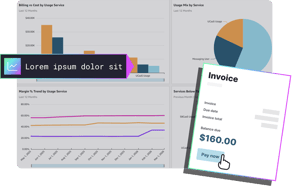
Hybrid Billing Built for How Enterprise Monetization Actually Works
Inceptos nec justo mollis a adipiscing etiam primis velit nisl

Suspendisse fusce egestas praesent parturient ornare fringilla a massa ultricies

Donec viverra a nisi ac class

The Reality: Most Billing Models Become Hybrid

Very few businesses stay “subscription-only” or “usage-only” for long.
sample-illustration

As products mature and customer needs diversify, monetization evolves into combinations of recurring, usage-based, and contract-driven pricing models.

Subscription models expand to include usage allowances, overages, commitments, and multi-service bundles that must all work together accurately.

Common patterns include:

  • Subscriptions with usage overages

  • Tiered plans with consumption thresholds

  • Committed spend with true-ups

  • Bundles combining recurring, usage, and one-time charges

  • Add-ons, implementation fees, and service charges

  • Multi-product contracts with different billing rules

Hybrid billing is where growth happens. It is also where legacy billing systems start to break.

Why Hybrid Billing Is Hard to Get Right

Hybrid billing introduces operational and technical complexity that most systems cannot handle cleanly.
sample-illustration

Common failure points include:

  • Disconnected engines for subscription and usage billing

  • Inconsistent application of contract terms across products and services

  • Revenue leakage caused by rating errors, misapplied pricing, or billing exceptions

  • Manual reconciliation between usage records, billing systems, and financial systems

  • Slow rollout of new pricing models because every change requires custom development

  • Customer disputes driven by unclear or unpredictable invoices

  • Inability to manage usage buckets, allowances, and overage logic consistently

The result is a billing operation that becomes reactive and fragile as the business scales.

What Enterprise-Grade Hybrid Billing Requires

Hybrid billing works when it is treated as a core platform capability, not a collection of disconnected features. To support hybrid monetization at scale, organizations need:

Unified rating and billing logic

Apply usage, recurring charges, and contractual pricing rules consistently using real-time and batch rating within a single system.

Support for complex commercial models

Handle subscriptions, usage, bundles, commitments, tiers, minimums, overages, discounts, prepaid balances, and one-time charges together.

Contract-driven flexibility

Manage customer-specific agreements across pricing, usage, and billing without creating one-off processes for every deal.

Hierarchy-aware billing and pooled usage

Support parent-child account structures, shared usage pools, and flexible billing ownership across enterprise customers.

Invoicing clarity and control

Generate invoices that customers can understand and finance teams can trust, even when charges span multiple billing types.

Finance-grade traceability

Ensure billing outcomes can be validated and audited from usage through invoice, especially in high-volume environments.

Usage-based pricing best practices

How do I make sense of my usage data?

For high-tech organizations, usage data is an important source of information to measure performance. Usage data not only provides clarity into the customer’s actual usage habits, but also helps you answer questions about how product features are being used, and what to develop next.

With the help of today's cloud technologies, it's possible to track usage data from phone calls, data, API, minutes, etc., and charge for it appropriately.

Once you've captured the usage data, you'll need to review them for any possible errors that need to be fixed and reprocess the failed records. This process of data transformation requires a robust usage-based billing software.


How do you forecast revenue with usage pricing models?

With usage-based pricing models, customers are charged based on their usage, so the revenue generated is variable and is determined by the number of resources used by the customer. Forecasting usage revenue has become quite common for tech, SaaS, IoT, and professional services industries. In order to correctly forecast recurring revenue generated from usage, historical sales data, annual recurring revenue (ARR) history, and customer usage patterns need to be taken into account.

The most important thing to look at when assessing revenue is the previous year's annual recurring revenue (ARR) and usage. This will help you predict how it may affect the next year’s ARR. The other key metrics to look at when forecasting recurring revenue are monthly recurring revenue (MRR), customer lifetime value (CLV), customer acquisition costs (CAC), and customer churn rate. Forecasting customers’ future usage works best when you have access to accurate data, which can then enrich revenue forecasts. An agile usage-based billing system can provide accurate usage data for recurring revenue forecasts.

Who should consider going usage-based?

You should consider switching to a usage-based billing model if your customers demand convenience, flexibility, and fairness in pricing. Usage-based pricing is best suited for businesses that offer high-volume transactional services, and it has the ability to track customer usage based on the chosen value metric be it API calls, minutes, downloads, etc. which requires you to automate your billing system. The following businesses can get the best benefit from usage-based billing:

  • Cloud apps and infrastructure companies
  • IoT (Internet of Things) companies
  • Software as a service (SaaS) companies
  • Utility companies
  • Telecommunication businesses
  • Financial services companies that process a high volume of transactions
  • OTT service providers, and streaming service companies, etc
  • Telematics industry
How does usage-based billing work?

Usage-based billing allows you to charge customers based on resources they have consumed, rather than overcharging them for resources they have underutilized. It helps businesses develop attractive client-oriented services that ultimately drive revenue growth. Usage-based pricing allows your business to expand your customer base by removing flat-fee pricing which reduces the initial purchase barrier.

The model allows businesses to create various pricing tiers to fit the customer’s needs. These thresholds or tiers determine the amount you can charge per data that's collected, versus just charging a flat fee. By strategically placing thresholds, businesses can increase revenue based on consumption.

What are the top things I should consider for usage pricing?

When transitioning from subscription to usage-based billing, there are many factors that need to be considered like the different types of customers and the variability of their usage. It is advisable to consider both go-to-market and operational challenges in setting the right price and billing frequency. In order to capture value from customers, companies must think through and execute the following steps:

  1. Choose a usage billing metric that your customer associates with your product value
  2. Determine the usage-based pricing model best suited for your business, product offering, and target customer
  3. Choose a configurable usage-based billing provider that can manage complex billing scenarios and integrates with all the software you use
  4. Determine the usage-based rating rules, and ensure you provide real-time access to usage and rating data
  5. Update your marketing material to reflect the changes in the billing and launch the new pricing model
  6. Make sure your sales team can communicate the value proposition of your product and new pricing model to customers
  7. Inform your customers about the new pricing model and the changes they will expect to their invoices. Also, educate them about the transparency in pricing this model will offer

How LogiSense Enables Hybrid Billing

sample-illustration

LogiSense provides a unified foundation for hybrid monetization so you can scale complex pricing without creating operational bottlenecks.

  • Launch new pricing models faster - Support evolving monetization strategies, including hybrid subscription and usage models, without rebuilding your billing stack or maintaining fragile integrations.

  • Reduce revenue risk and operational overhead - Minimize manual adjustments, billing exceptions, disputes, and reconciliation effort that lead to leakage and inefficiency.

  • Support complex hybrid models with confidence - Operate subscriptions, usage-based pricing, commitments, pooled usage, and multi-service bundles within a single platform.

  • Align teams around one source of truth - Give Product, Finance, and IT shared confidence in usage processing, pricing logic, billing execution, and reporting outcomes, with full traceability across systems.

Who This Is For

sample-illustration

Hybrid billing is designed for enterprises where pricing complexity is strategic and revenue outcomes must be trusted.

Ideal for:

  • SaaS and XaaS businesses moving to hybrid monetization

  • AI, API, and data-driven services combining plans and consumption

  • Communications providers packaging plans with usage, tiers, and commitments

  • Companies introducing bundles and multi-product customer agreements

  • Enterprises replacing legacy billing systems that cannot support modern pricing

Designed for Complexity Without Risk

sample-illustration

This is for organizations where:

  • Monetization combines subscription, usage, and contract-driven pricing

  • Customer relationships involve complex hierarchies and shared usage models

  • Pricing is evolving rapidly and must be supported without operational disruption

  • Systems must scale without sacrificing accuracy, control, or transparency

Hybrid billing is a trust conversation. Buyers need confidence that the platform can handle complexity without introducing risk.

LogiSense is built for enterprise environments where hybrid billing must be accurate, scalable, and auditable.


Trusted by leading companies

cisco-logo
vonage-logo
garmin-logo
five9-logo
motorola-logo
viatel-logo
8x8-logo
sierra-logo

Let's talk

If any of this sounds familiar, a 30-minute conversation is the fastest way to find out what's possible.
  • Diam a sem elementum a accumsan nec adipiscing litora condimentum
  • Proin duis mollis eros nostra class ipsum a molestie ut
  • Eu habitasse tincidunt sit nisl amet class cras sed et vitae ultricies
  • Elementum suspendisse cras quisque a. Feugiat eros mus in non etiam eros

Subscribe to our newsletter