

The pace of change across the technology and SaaS landscape continues to accelerate. New products emerge quickly, AI transforms workflows, and buying behavior shifts toward digital-first experiences. Yet despite this evolution, Sangram Vajre argues that the single biggest determinant of success in 2026 will not be a new product launch, a breakthrough AI enhancement, or even a new sales motion. The deciding factor will be something far more foundational: internal clarity on go-to-market.
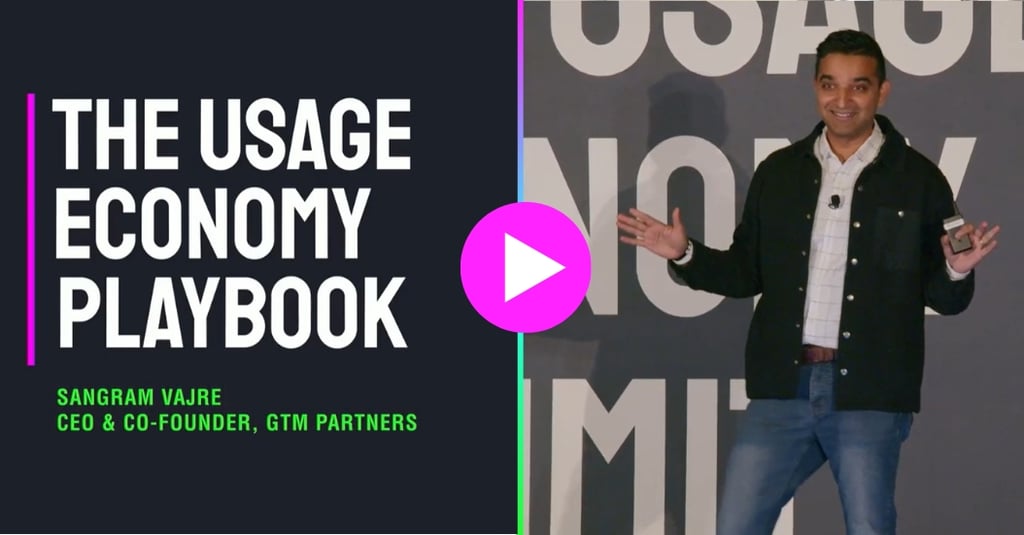
At the Usage Economy Summit 2025, Sangram delivered a compelling reminder that go-to-market is not a department. It is the business itself. Every executive, every leader, and every team member plays a role in shaping how a company wins, expands, and retains its customers.
The Go-to-Market Problem No One Talks About
Sangram opened with a simple exercise: define go-to-market. As attendees quickly discovered, the answers varied dramatically. Marketing leaders emphasized demand and brand. Sales leaders focused on pipeline and conversion. Product leaders highlighted roadmap and capabilities.
This inconsistency is pervasive across the industry. In Sangram’s research, spanning startups and billion-dollar enterprises, every executive described go-to-market differently. When teams cannot agree on the definition of the problem, they cannot align on the solution.
The first strategic takeaway is therefore straightforward:
Every organization must formalize its own definition of go-to-market.
This definition will depend on the company’s operating model. A product-led business will define GTM differently than a category-creator or a sales-led enterprise. What matters is alignment, not uniformity.
NRR: The Metric That Predicts a Company’s Future
Sangram reinforced a point that resonates strongly across the Summit: net revenue retention is the single most important indicator of business health.
His research shows that companies operating below 100 percent NRR are on a downward path. Companies at or above 120 percent NRR, especially in private markets, represent rare but elite performance. These high-performing organizations consistently outperform peers regardless of product category, market segment, or pricing model.
Every leader must therefore know their company’s NRR, understand its drivers, and align their work to improve it. Customer expansion and retention are no longer optional. They are existential.
Growth Happens in Stages: Problem, Product, Platform
Sangram introduced a simple but powerful maturity model:
- Problem – proving you are solving a meaningful pain.
- Product – achieving product-market fit and repeatability.
- Platform – expanding across products, personas, and markets.
Nearly every successful company progresses through these stages. Yet many organizations stall between product and platform. According to the research, 80 percent of companies that fail to transition into platform status eventually decline or disappear.
The implication is clear: growth strategy must be tied to the company’s stage, and executive teams must be aligned on where they truly are.
The GTM Operating System: Eight Questions That Drive Alignment
Sangram revealed the Go-to-Market Operating System, an eight-question framework used by high-performing companies with exceptional NRR. These questions force disciplined thinking and remove ambiguity.
The first question alone reshapes most strategic conversations:
Where can we grow the most?
Not “where can we grow” but “where can we grow the most.” This qualifier forces teams to discuss market size, margins, customer value, ICP focus, and the real trade-offs required.
Each of the eight questions serves as a governance tool. They create a structured cadence for leadership teams to align, debate, and make decisions. According to Sangram, the best organizations do not rely on goals alone. They rely on systems.
Real-World Examples: How Great Companies Operationalize GTM
To demonstrate how these principles manifest in practice, Sangram shared several case studies:
Notion
Once on the verge of collapse, Notion rebuilt its strategy around community-driven adoption and radical ease of use. Their central GTM question became: What is our point of view?
HubSpot
HubSpot won by defining a category rather than competing in an existing one. Their differentiated POV became the cornerstone of their go-to-market system.
Snowflake
Snowflake transformed the sales motion by removing procurement barriers and encouraging customers to try the platform before paying. This usage-first model reshaped cloud adoption and set a new standard for frictionless enterprise selling.
Across all examples, the theme is consistent. High-performing companies align around a clear GTM system, not isolated tactics.
The Market Is Changing: Services, Usage, and Invisible Interfaces
Sangram outlined three macro-shifts shaping the next era of business:
- Rise of services as software – usage-based models and hybrid monetization are becoming the norm.
- Shift in buying behavior – digital self-service is increasingly preferred, even for high-value deals.
- Rise of invisible platforms – interfaces will become embedded, automated, and AI-native, changing how products are built and used.
The future will reward companies that build workflows instead of static products and that operate from a unified internal operating system rather than siloed departmental plans.
A Blueprint for 2026 Planning
Sangram closed with several directives for leaders preparing for 2026:
• Define go-to-market and make it explicit.
• Know your NRR and align your work to improve it.
• Use the eight-question GTM Operating System to guide planning.
• Adopt a platform mindset and build for expansion.
• Develop a differentiated point of view.
• Focus on ROI in the customer’s mind, not your own metrics.
• Recognize that AI is not the strategy. Alignment is.
The companies that succeed will be those that replace ambiguity with clarity and replace siloed goals with shared systems.
Sangram’s full presentation brings these ideas to life with clarity and energy. I encourage you to watch the session and hear directly from him how your organization can build a stronger go to market foundation for 2026.
Comments