

The rise of autonomous AI agents marks a pivotal shift in enterprise technology. Powered by large language models (LLMs), these agents can reason, act independently, and automate complex workflows across sales, customer support, engineering, compliance, and beyond. CB Insights’ recent report, “Future of the Workforce: How AI Agents Will Transform Enterprise Workflows“, paints a compelling picture of this shift — but also raises a critical question: how do companies operationalize AI agents in ways that deliver measurable business value?
For product leaders, the challenge isn’t just adopting AI — it’s aligning innovation with business outcomes. That means embedding a monetization mindset into the very architecture of AI deployment. Cost reduction and efficiency are important. But long-term success lies in ensuring that AI contributes to sustainable value creation — whether through external monetization, internal cost attribution, or new pricing models.
This is where platforms like LogiSense provide a crucial bridge between innovation and impact.
The Promise of AI Agents
Autonomous AI agents represent a step-change beyond chatbots and copilots. Unlike traditional assistants that require prompting, agents are goal-oriented systems that can independently plan and execute tasks. CB Insights highlights their potential in:
- Replacing human customer service agents (e.g., Klarna’s AI handles the work of 700 reps)
- Automating outbound sales outreach (e.g., Claygent’s task-based SDRs)
- Writing and debugging software (e.g., Cognition AI’s coding agent Devin)
- Streamlining compliance and reporting (e.g., Norm AI, Hebbia)
- Managing entire enterprise workflows with minimal human oversight
The investment landscape reflects this momentum, with hundreds of millions of dollars flowing into startups building agentic systems. Major players like Google, Microsoft, and Amazon are rapidly evolving their own AI agent capabilities.
But for all their potential, these agents are not plug-and-play. The road from prototype to production — and from production to profit — is riddled with challenges.
Why Operationalization Is the Hard Part
As the report makes clear, most AI agents remain early in their development. Many lack reliability, especially when it comes to interacting with external tools, chaining complex actions, or handling sensitive workflows. Adoption is hindered by:
- Trust gaps in autonomous decision-making
- Inconsistent performance across environments
- Challenges with integration into existing enterprise systems
- No clear financial models to capture value
For product leaders, this means that bringing an AI agent to life is not just about the model — it’s about the infrastructure. It’s about how the agent is packaged, priced, delivered, tracked, measured, and, ultimately, how it contributes to business objectives.
Embedding a Monetization Mindset
Monetization doesn’t always mean selling a product. In the context of AI agents, it can include:
- External monetization: Charging customers for AI-powered features based on usage or value.
- Internal chargebacks: Cost attribution for AI resources used across departments.
- Tiered access models: Offering different agent capabilities to different customer segments.
- Outcome-based pricing: Charging per task completed, lead qualified, or issue resolved.
These models require fine-grained usage tracking, flexible pricing structures, and real-time billing capabilities — none of which traditional systems are equipped to handle.
How LogiSense Bridges Innovation and Value
LogiSense is purpose-built for modern monetization — especially in environments where pricing must be flexible, consumption must be tracked at scale, and each customer engagement may be uniquely structured.
For AI agents, this means:
- Tracking usage at the task, transaction, or API-call level
- Supporting complex pricing models, such as drawdowns, minimum commitments, or volume tiers
- Offering customer-specific pricing without catalog sprawl
- Automating billing and reconciliation even as usage scales rapidly
- Applying contract terms dynamically to ensure monetization aligns with promises
This monetization backbone is essential for product teams operationalizing AI. Whether you’re launching a new AI-powered feature, offering a virtual agent for enterprise support, or embedding intelligence into internal workflows — if you can’t meter it, rate it, and invoice it, you can’t scale it.
The Strategic Imperative for Product Leaders
CB Insights makes it clear: autonomous agents will shape the future of work. But it’s product leaders who will determine whether that future generates real business value.
Embracing a monetization mindset means thinking beyond the model to the entire product experience — from delivery to pricing to revenue realization. It means designing with operationalization and scalability in mind from the outset.
AI innovation without this mindset risks becoming a cost center — compelling in concept, but fragile in execution. With the right monetization infrastructure, it becomes a strategic growth engine.
Conclusion: Innovate with Intent, Monetize with Precision
The age of AI agents is here — but success won’t come from hype alone. It will come from building scalable, sustainable systems that deliver business value.
LogiSense helps product leaders operationalize and monetize AI — turning intelligence into impact.
If your organization is building the next generation of AI-powered experiences, now is the time to align innovation with monetization. Because in the end, product excellence is not just about what you build — it’s about how you bring it to market and how you make it pay off.
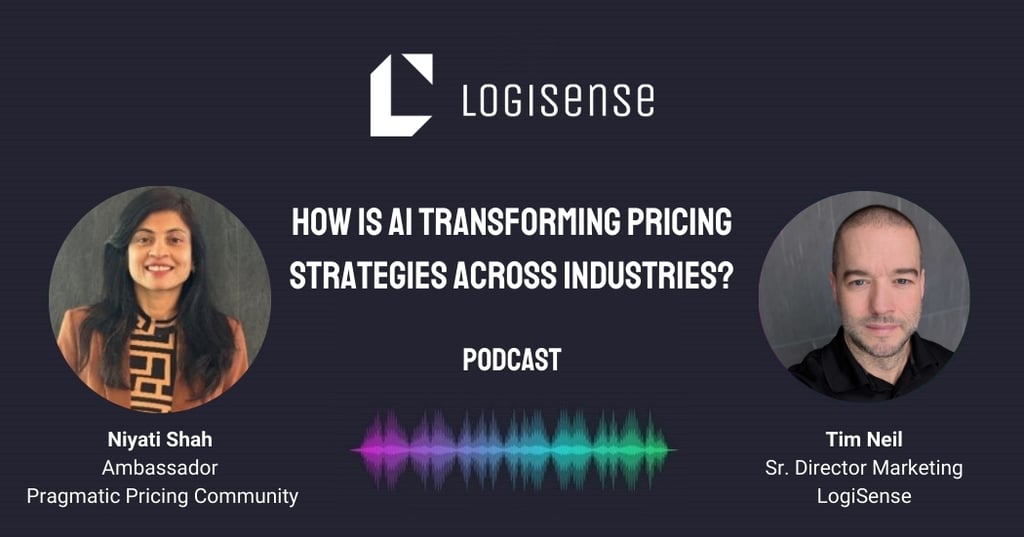
How is AI transforming pricing strategies across industries?
We sat down with pricing and finance strategy expert Niyati Shah—whose experience spans Cisco, Intel, Logitech, and Synopsys—to explore how organizations are adapting their monetization strategies in an AI-driven world.
Whether you’re in Product, Finance, or Revenue Operations, this discussion will change the way you think about pricing innovation. Watch the podcast.
Comments