

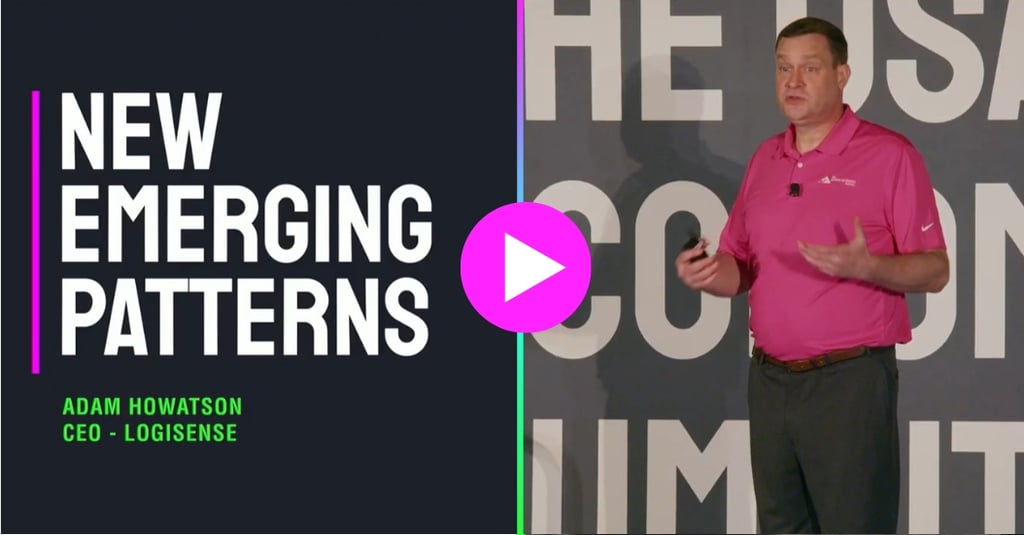
At this year’s Usage Economy Summit, Adam Howatson, CEO, LogiSense, opened the day with a direct message about the world we’re navigating. The long period of global stability that defined the last century has given way to a landscape shaped by volatility. Supply chain swings, financial uncertainty, shifting economic forecasts, and evolving buyer expectations have created an environment where traditional commercial models no longer hold. In 2025, uncertainty has become the only constant.
Adam emphasized that companies cannot afford to rely on historical playbooks. The way organizations sell, price, package, and prove value must adapt to the new realities of the market. Growth is no longer driven solely by product innovation or broad demand generation. Success now hinges on the ability to demonstrate tangible, measurable value at every stage of the customer relationship.
The New Commercial Battleground
In this climate, differentiation is increasingly achieved through the commercial model. CFOs and CEOs are more cautious, sales cycles are longer, and budgets are scrutinized more tightly. To win new business, vendors must clearly show how they help customers either save money or make money. Anything less fails to clear the approval threshold.
Adam pointed out that this shift has elevated the strategic importance of net revenue retention. Markets are not expanding without limit, so retaining and expanding existing customer cohorts is just as important as acquiring new ones. Companies that invest in customer experience, personalization, and transparent pricing outperform those who rely exclusively on traditional marketing and outbound tactics. A disciplined approach to pricing and value communication is no longer optional. It is a requirement.
Why Usage and Hybrid Monetization Models Matter
At the center of Adam’s vision is the growing role of usage-based and hybrid monetization strategies. Pure usage-based pricing currently represents around 20 percent of SaaS go-to-market models. However, hybrid structures that blend a baseline commitment with consumption-based upside are quickly becoming the preferred model for companies seeking to align price with value.
These models offer several important benefits. They provide transparency, create fairness in the commercial relationship, and allow customers to pay only for what they use while still giving vendors predictable recurring revenue. They also help vendors stand apart from competitors who rely on rigid, legacy pricing models that fail to reflect real value delivery.
Adam also highlighted that customers themselves are changing. As digital self-service becomes normal in B2B buying, nearly 40 percent of buyers express a willingness to make purchases up to $500,000 entirely online. This represents a fundamental shift in buyer behavior. Vendors must now design pricing models, packaging, and digital journeys that support self-selection without requiring traditional sales interactions. Empowering the buyer is no longer an advantage. It is becoming a baseline expectation.
The AI Reality Check
While AI continues to dominate headlines and conference stages, Adam urged the audience to treat AI with discipline. Many AI projects fail to produce measurable value because their application is unclear or disconnected from customer needs. Introducing AI features that customers did not ask for, and then increasing pricing to compensate, risks creating frustration and eroding trust.
The message is simple. AI can be powerful when it solves a real problem and delivers defined outcomes. Vendors must be able to clearly articulate how AI improves customer results, how it ties to value realization, and why it deserves investment. Without that clarity, AI becomes a cost without a purpose.
Building Trust and Demonstrating Value
Adam underscored that trust is a critical component of modern monetization strategies. Customers must know exactly what they are paying for, how their usage is trending, and where value is being created. Transparent communication with the office of the CFO is essential. Companies adopting usage or hybrid models must build mechanisms that eliminate billing surprises and provide customers with real-time visibility into entitlements, consumption, and projected costs.
Ultimately, trust, clarity, and speed to value define the vendors who will succeed in the next several years. Demonstrating ROI quickly is more important today than at any point in the last decade.
Guidance for Companies Moving Toward Modern Monetization
Adam closed his keynote with practical recommendations for organizations exploring usage, hybrid, or value-based pricing models. Companies should:
- Evaluate competitor pricing and go-to-market motions.
- Begin with hybrid tiers to reduce risk and show early value.
- Modularize packaging to support flexible add-ons.
- Invest in digital buying journeys that support self-service.
- Strengthen net revenue retention by focusing on customer experience.
- Equip sales teams with clear ROI narratives and financial models.
- Align pricing with delivered outcomes rather than internal assumptions.
The objective is not merely to adjust pricing but to modernize how companies communicate value, build relationships, and sustain long-term revenue growth.
A New Era of Monetization
Adam closed with a reminder that the market has changed. It is no longer enough to grow. Companies must grow responsibly, sustainably, and with a clear connection between price and value delivered. Monetization models are becoming a key competitive differentiator. In an economy defined by disruption, organizations that align their pricing structures with customer outcomes will be the ones that stand out.
You can now watch the full recording of Adam Howatson’s keynote to explore his insights in greater depth. The session provides a clear view of the trends, strategies, and recommendations that shaped this year’s summit.
Comments